Pre-race analysis
Soft-tyre degradation will reward pit-stop strategy
Before the Spanish Grand Prix at Barcelona on Sunday 14 June 2026, we studied the timing and telemetry and wrote down our predictions: how each dry tyre would wear, and what that does to the race. Pirelli gave every team the same three compounds this weekend, one step softer than last year. Here are the predictions and the chart behind them.
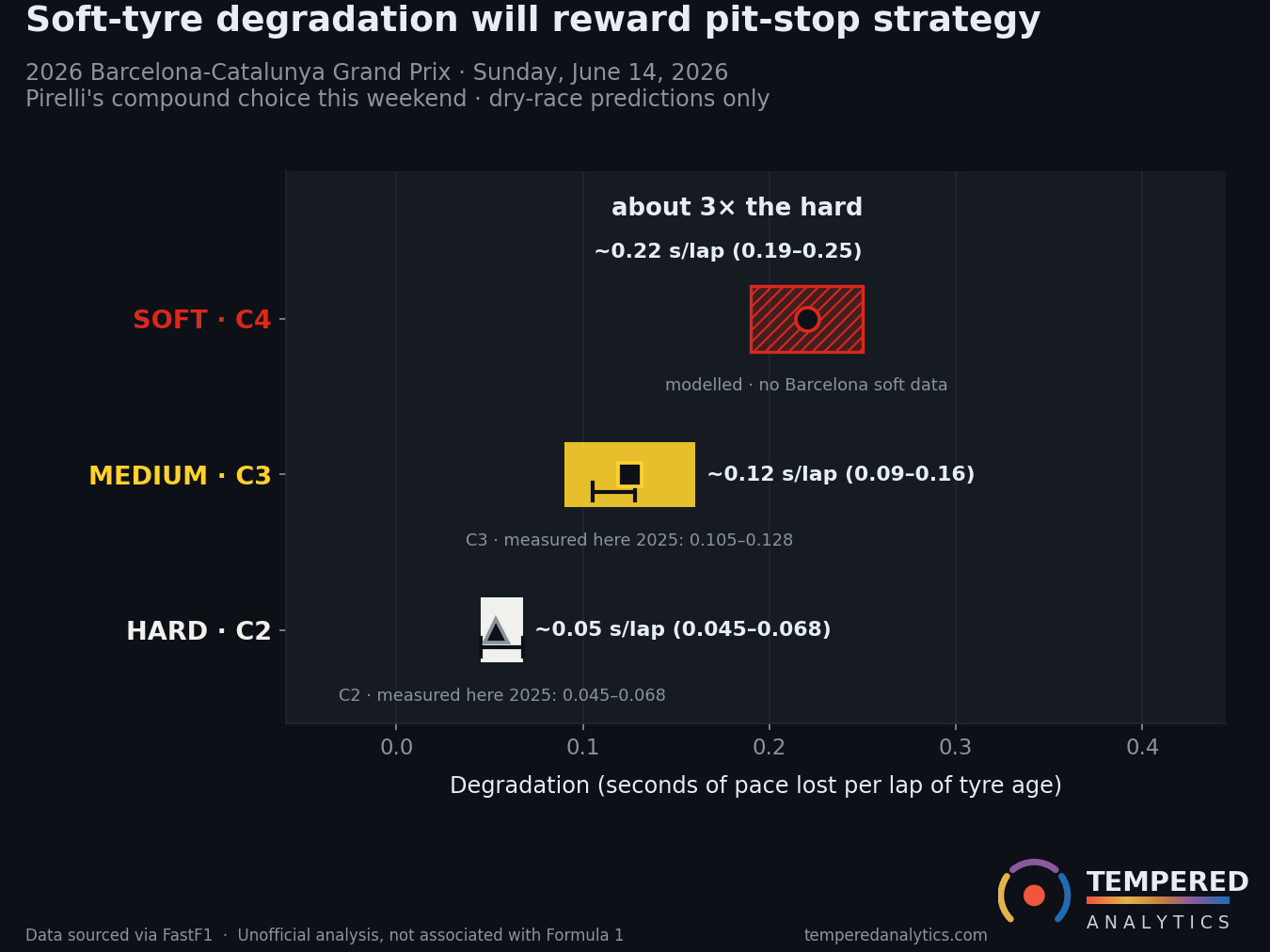
The shape of the prediction is simple. The soft should wear about three times as fast as the hard, fast enough that no one can simply run it, so it is a launch or late-sprint tyre, not a stint plan. The medium is the workhorse, but it pays for the pace: by lap 15 it is already giving up well over a second a lap to fresh rubber. That is what makes the undercut so sharp this weekend: pitting first for new tyres while a rival stays out on worn ones. The hard barely fades, which makes a car on the hard almost impossible to undercut, and the hard the backbone of the long stint. Across 66 laps only the hard can carry a long stint, so two stops is the default shape, and the race turns on when you change tyres, not how fast you lap.
The predictions, before the race
Written down before lights out:
- The medium degrades at least 1.5 times the hard, on race stints.
- The soft degrades about 0.22 seconds a lap, roughly three times the hard. This one comes from our model, with no measured Barcelona soft data behind it.
- A green-flag pit stop costs 21–24 seconds. Measured here last year: 22.5 seconds median.
- In a dry race, the winner's longest stint comes on the hard. The backbone claim, made where it can fail.
If the race is wet, the wear predictions do not stand. After the race we check each prediction against what the race measured, right or wrong. If we are wrong, you will see it in our own charts.
The basis for this prediction
- Straight from the source. Every number comes from the sport's public timing and telemetry, never broadcast footage or official graphics.
- One assumption, stated plainly. Our 2026 adjustment leans on a single track raced by both car generations on the same asphalt with the same compounds. That gives direction and rough size, not precision, and the 2026 tyres are a new construction, so we compare by compound lineage, not by name.
- Clean laps only. The wear numbers use the laps that show the tyre's true pace, with safety-car laps, traffic, and pit-lane laps set aside.