Post-race check
How we got 3 predictions correct, but missed on the soft
Before the Austrian Grand Prix we wrote down our tyre predictions. After the race, we analysed the accuracy of our predictions and are sharing the results here. The hard and the medium wore almost exactly as we said. The soft, the one prediction we modelled, wore far gentler than we predicted, the lowest of the three.
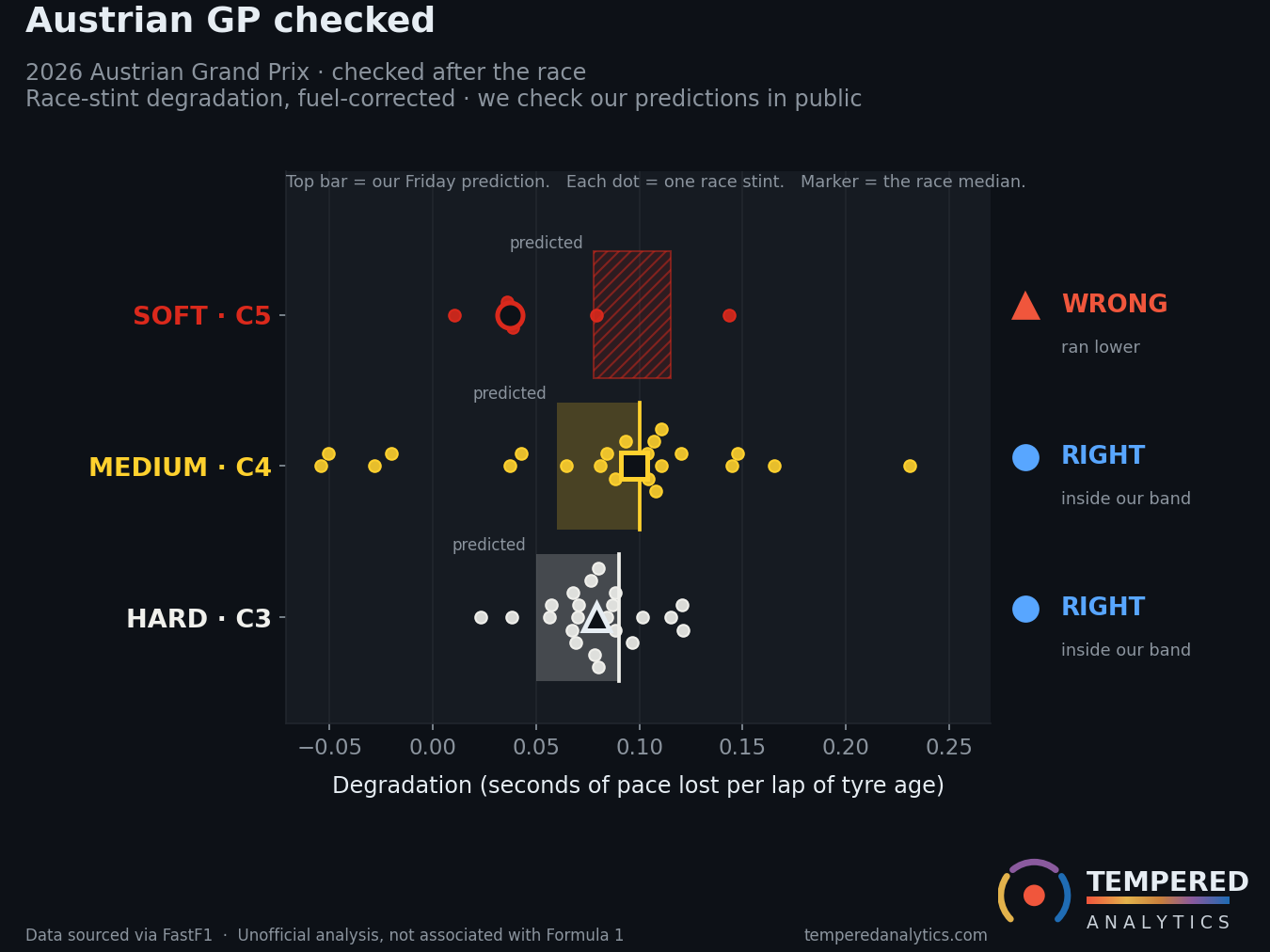
Pre-race we predicted small differences in degradation between compounds and the race data confirmed this. The hard degraded at 0.079 seconds a lap and the medium at 0.097, so the medium wore 1.23 times the hard, well under the 1.5 times we drew the line at. On this track the three compounds wear close together, and the race tends to turn on track position more than on the tyre.
The results, prediction by prediction
Each prediction as written before the race, against what the race measured:
- The medium degrades under 1.5 times the hard. Measured 1.23 times. Right.
- The hard degrades between 0.05 and 0.09 seconds a lap. Measured 0.079. Right.
- The medium degrades between 0.06 and 0.10 seconds a lap. Measured 0.097. Right.
- The soft degrades about 0.09 seconds a lap, roughly 1.4 times the hard. Measured 0.037, about 0.47 times the hard. Wrong. The opposite of what we predicted: it wore the lowest of the three.
The soft is the one we got wrong, and the why is more useful than the miss. We had one soft stint from 2025 here, so we modelled the soft rather than measuring it and widened the range to about 0.078 to 0.115 seconds a lap. The race gave us six soft stints, at 0.037 seconds a lap, less than half the 0.09 we predicted. But the soft was only ever run early, in short stints of about 11 clean laps and never taken past about 23 laps of tyre age, while the hard ran to 36. Degradation steepens as a tyre ages, so a tyre only ever seen in its gentle opening laps looks gentle: we measured the soft over short windows, not the long runs our model was built for. The six stints spread wide, from almost no wear to steep, so the median rests on a small sample.
So the soft wearing lowest is true of the windows it ran, not a clean compound-to-compound comparison: it was never asked to do a long run. We set the range before the race and did not move it, so a result below it is a miss we own, and the heat hazard the FIA declared for the race does not excuse it: we flagged that as context before the race, never as a reason to move the range. The race did give us a real soft measurement here, 0.027 to 0.053 seconds a lap, and next time our soft prediction at this track will start from that measurement, not from a model.
How we checked
- Against the words we wrote. Each prediction was written down before the race, and we checked it against those exact words, never against a number nudged after the fact.
- Measured from the race itself. The wear numbers come from the race's own clean laps, fuel-corrected: 364 hard laps, 248 medium, 64 soft.
- Right or wrong, in our own charts. We were wrong about the soft, and you are reading it here first. We check every prediction after the race, and you see the misses as plainly as the hits.